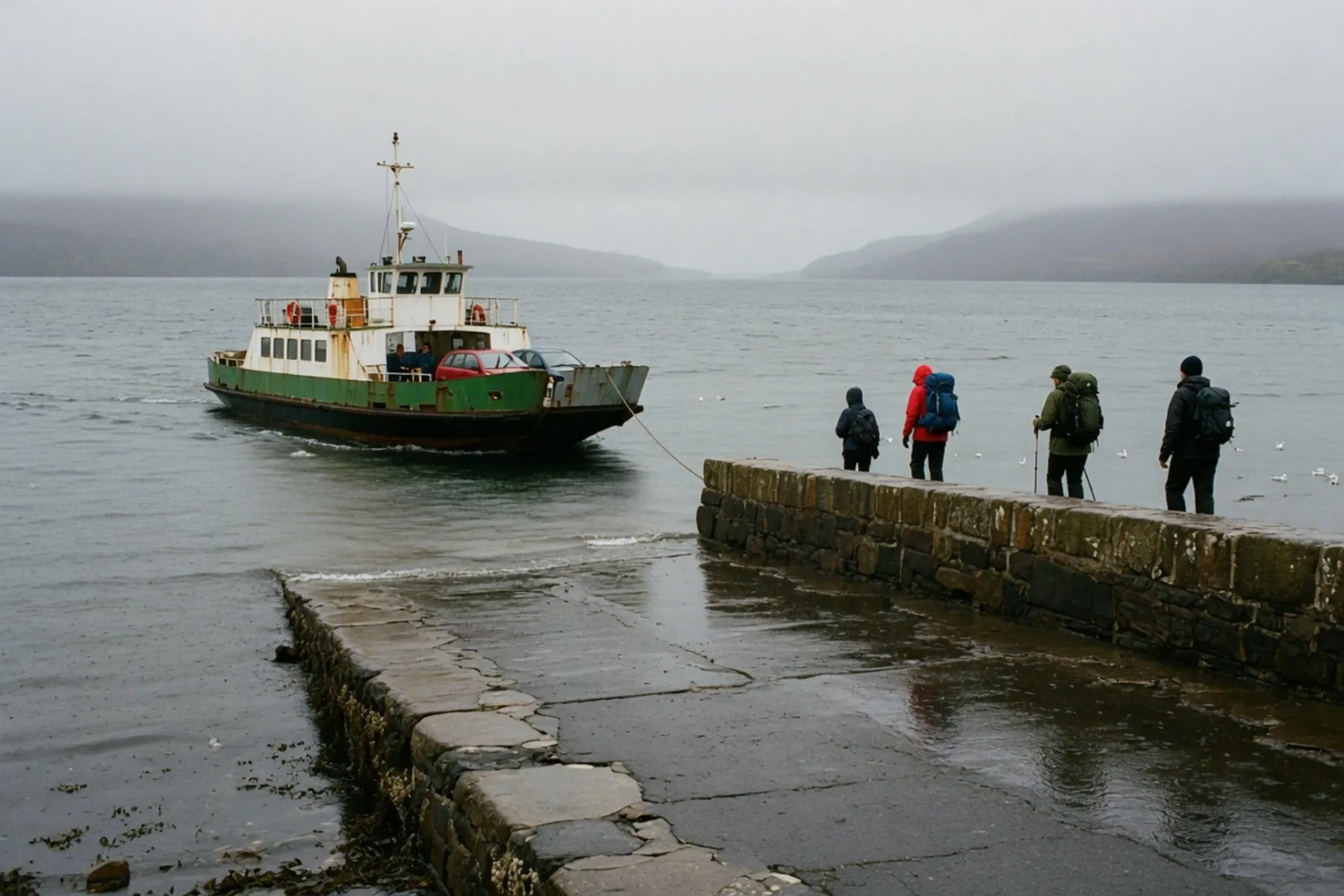
Fort William works without a car better than most Highland towns, because three separate networks converge on it: a mainline railway, a web of local buses, and two ferries across Loch Linnhe. The town itself is small enough to cross on foot, and almost every direction out of it — up Glen Nevis, south to Glencoe, west to Mallaig, across the water to Ardnamurchan — has a scheduled service. What a car-free visit needs is a sense of which operator runs which leg and how far each one goes, because the timetables are seasonal and the connections are not always timed to meet. Get those two things right and the place opens up.
The West Highland Line brings the trains in. ScotRail runs a direct service from Glasgow Queen Street to Fort William by way of Crianlarich, Rannoch and Tulloch, and on a sample weekday checked in late October the fastest journey came in at about three hours forty minutes. That is indicative rather than a timetable: departures move with the day and the season, so check ScotRail for the date you are travelling. Edinburgh means a change at Glasgow Queen Street, and London changes at Glasgow Central and then walks the few minutes across to Queen Street, so both are slower. The station is a short walk from the High Street, which makes the train the simplest arrival if you are staying in the centre.
Most of what you need in Fort William sits in a compact strip between the station, the High Street and the lochside. The West Highland Museum, the shops and cafés of the High Street, the station and the local bus stops are all a few minutes’ walk from each other, and the town pier where the Camusnagaul ferry leaves is beside the Crannog restaurant. The one place that sits outside that easy walk is An Aird, the coach interchange on the edge of town where Citylink and Ember set down. If you arrive by coach, do not assume you are in the centre — the two networks use different ends of town.
Shiel Buses is the local operator, a family firm running since 1978, phone 01397 700 700, and it is the one to learn if you are staying more than a day. The 41 runs from Roy Bridge through the Nevis Range to Fort William. The 44 and 144 run to Kinlochleven via the Corran Ferry, Onich, Ballachulish and Glencoe, so they cover a loop of Lochaber without retracing steps. The 500 is the long one, Mallaig to Fort William by way of Glenfinnan, serving the viaduct and the west-coast villages. The 506 and 507 cross the Corran Ferry onto the Ardnamurchan peninsula, from Kilchoan and Lochaline. Current times and per-route fares sit on the timetables-and-fares page of the Shiel Buses website, and they move with the season, so read them for the week you are here.
The Corran Ferry crosses Loch Linnhe to Ardgour, and it is the gate to Ardnamurchan and the roads to Strontian, Kilchoan and Lochaline. Highland Council runs it every day of the year except 25–26 December and 1–2 January, the crossing takes about five minutes, and shuttle sailings run through the day on top of the scheduled ones — first come, first served, with priority to emergency vehicles and scheduled buses. Foot passengers pay £2 and holders of a concessionary pass travel free, a pedal cycle goes free, a motorcycle £6, a car £13, a campervan up to six metres £18, and a motorhome between six and eight metres £23.50. Card is preferred and cash is accepted, and these fares took effect on 1 May 2026, so check the Highland Council ferry pages rather than an old write-up. The ferry office is on 01855 841243.
The shortest crossing from the town is the Camusnagaul foot ferry, a small passenger boat from the town centre pier, beside the Crannog restaurant, over to the Ardgour peninsula. It runs all year for walkers and cyclists, the crossing taking about ten minutes, and it reaches the Ardnamurchan side without first riding out to Corran. Sailings run Monday to Saturday only; a Sunday crossing is possible by advance arrangement at a £100 charge. From Fort William the boat leaves at 08:00, 10:30, 12:20, 16:15 and 17:30, the last a request-only sailing booked by 17:00, and it returns from Camusnagaul at 08:15, 10:45, 12:30 and 16:35. An adult pays £2, a child £1, a cyclist £3.50, the National Entitlement Card is accepted and dogs are welcome. The operator is Dougie Robertson on 07468 417 137 — ring ahead in bad weather, because a small boat in a big loch keeps its own counsel.
The classic day out west runs on two schedules. The Shiel 500 bus runs Mallaig to Fort William through Glenfinnan, so the viaduct and the lochside villages are reachable any day the bus runs; check its times on the Shiel Buses page. The other option is the Jacobite steam train from Fort William to Mallaig, which crosses the Glenfinnan Viaduct the way every film audience knows. The train’s season, times and booking are in the Jacobite article, so read them there; the useful point for a car-free trip is that bus and train start from the same town, so one day can be Mallaig out and Glenfinnan back.
South is the easiest direction without a car, because two services overlap. Scottish Citylink’s 915 runs Glasgow to Fort William and Skye through Glencoe, and in the glen it works on request stops — stand where the driver can see you and flag clearly, and press the bell to alight, or the coach will not stop. The Shiel 44 and 144 take the local route through Kinlochleven, Onich, Ballachulish and Glencoe, so the two operators between them cover the glen for most of the day. What to do when you get there — the visitor centre, the Lost Valley, Signal Rock, the Lochan — is in the Glencoe article; this page is about the getting there.
Two coach networks reach Fort William, and they are worth telling apart. Scottish Citylink runs the 915, with related 913 and 976, between Glasgow, Fort William and Skye, about three hours from Glasgow, with a winter timetable running from 19 September 2026; book ahead, and the National Entitlement Card and Young Scot are accepted. Ember runs all-electric coaches — the E4 from Edinburgh via Stirling, the E5 from Glasgow, roughly every two hours from late October 2026, and the E14 between Inverness and Oban through Fort William. Ember coaches carry bookable bike and wheelchair spaces and flexible tickets, and they set down at An Aird rather than the town centre. Full Citylink times live in the PDF linked from its route page, and Ember’s site shows live departures; do not carry a printed timetable from a previous season.
The combinations are what make the place. The Ardnamurchan run is the strongest: the Corran Ferry crosses to Ardgour and the Shiel 506 or 507 then carries you out the peninsula, so a day can string a ferry, a lochside road and a distillery stop into one loop — check both timetables against each other, because the ferry and the bus are run by different bodies and are not timed to meet. Rail and ferry pair well too: a train one way and a crossing the other makes a two-leg day. For the shorter version, the Shiel 41 to the Nevis Range or the 500 to Glenfinnan are single-leg days with no connection to make, and the day-trips page covers the directions in more depth.
Everything above moves with the season, and the honest answer to whether you can do Fort William without a car is that you can, provided you plan against live timetables rather than a remembered one. Traveline Scotland is the single planner that holds buses, coaches and trains together, and it is where to start for any connection. Each operator’s own page — ScotRail, Shiel Buses, Citylink, Ember, Highland Council for the ferry — is the source of truth for its own service. The rail times here come from one sample weekday, and the ferry and bus times from the operators’ published schedules on the date of writing, so check the live versions for the day you travel, and check again the night before, because Highland transport runs on weather as much as on timetables.