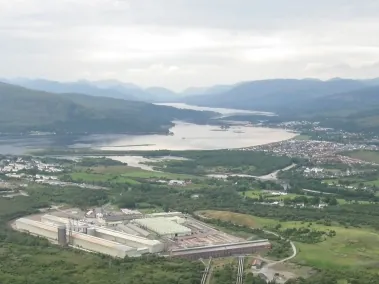
Corpach is a large village on the water north of Fort William, and it has the one thing the town itself lacks: a natural harbour. The canal lock at Corpach Basin, on Loch Linnhe east of the narrows leading into Loch Eil, is the western sea entrance of the Caledonian Canal — the point where a waterway cut clean across the Great Glen finally drops to salt water.
That is the reason to make the trip out. Fort William looks at the loch; Corpach works it. Boats coming down the glen finish here, and the flight of locks a little further up the line lifts them back inland. Around that sit a private mineral and fossil collection for a wet afternoon, a castle ruin you can walk round but not enter, and a viewpoint above the shore.
The straight-line distance from the town centre is 3.0 km, and Corpach’s own railway station is listed at 2.8 km. This is a short hop rather than a day out.
The basin is the working heart of the place, and the listings chop the same stretch of water into separate entries: Corpach Locks carries 4.7 from 47 Google reviews, Caledonian Canal, Corpach 4.5 from 37. Both are samples too small to lean on, and both describe much the same bank-side walk.
The one with real numbers behind it is Neptune’s Staircase, 4.5 from 5,135 Google reviews — the canal’s flight of locks, listed under Corpach and also under Banavie, the neighbouring village sitting next to Caol and Corpach. Whether you see it working is luck. A visitor in August 2026 wrote, “Amazing experience. We were lucky that there were four yachts going up the staircase when we visited.”
Parking divides people. One visitor in August 2026 warned, “Parking isnt very well signposted, or if there are signposts, not easy to see as the trees/bushes and weeds are so overgrown.” Another, the same month, had no such trouble: “Car park near the garage, just a short walk away with plenty of parking.” Both mention food at the locks; the second described “Plenty of place to eat & drink at whole watching the locks in use”.
Treasures of the Earth, 4.3 from 1,168 Google reviews, is the indoor option. A visitor in July 2026 gave it three stars and the most useful description of it: “A private rock and fossil collection now on display. This fairly small and a store attached. Ideal to visit on a rainy day.” Mineral enthusiasts get more from it — a visitor in August 2026 wrote, “Really really interesting and thoroughly enjoyed nerding out about minerals with the friendly and helpful staff.” Another that month called it a “Lovely little museum. Plenty of parking.”
Old Inverlochy Castle, 4.1 from 2,021 Google reviews, is the ruin in the listings, and the reviews are consistent: you cannot get in. A visitor in May 2026 put it plainly — “You can no longer get inside but still a cool visit if you’re in town.” One in August 2025 found it “closed to the public due to safety reasons but hopefully it will open again soon”, and one in May 2025 was drier still: “A ruin. Not possible to access. Nice view on the river and train bridge”. Go for the outside and the view, or do not go.
Two more entries are worth naming only in passing. Corpach viewpoint is listed as a hiking area at 4.8 from 21 Google reviews, and Old Boat of Caol at 4.5 from 49. Ratings that high on samples that small carry little weight.
The name is the darkest thing here. Corpach is reputedly based on the Gaelic for “field of corpses”, so called because the spot was perhaps used as a resting place when the coffins of chieftains were carried through on their way to burial on Iona. In about 1470 the Battle of Corpach saw Clan Cameron rout Clan MacLean.
The rest of the recorded history is military, and it follows from the harbour. In the First World War the United States Navy kept a base at Corpach as part of the laying of the North Sea Mine Barrage: naval mines were shipped in from the United States and then sent on to the Inverness base along the Caledonian Canal, which joins Loch Linnhe here. In the Second World War Corpach was the engineering base for HMS St Christopher, a training base for Royal Navy Coastal Forces, and some of those buildings are still in use.
The war left a settlement behind as well. A large camp at Annat became Annat Village afterwards — around 200 houses of a prefab type but built of stronger cement, flat-roofed, and some of the cement remains can still be seen about the area. The site is now used as a caravan site.
The train is the obvious way. Corpach has its own ScotRail station on Hillview Drive, listed at 2.8 km from the Fort William town centre and carrying 4.5 from 32 Google reviews, and the line out of Fort William runs west towards Glenfinnan, Arisaig and Mallaig. Fort William’s own station sits in the town centre, the bus station next door.
By bike it is easy, and the route is the canal itself. National Cycle Network Route 78 heading north out of Fort William towards Fort Augustus is mostly traffic-free, using canal towpath, forest track and the line of the old Invergarry and Fort Augustus Railway past Neptune’s Staircase. A flat local ride of about 10 miles runs along the Great Glen Way to the canal. Bikes travel free on ScotRail but need a reservation on longer routes, and West Highland Line trains take six per two-car unit.
Buses are the gap. No scheduled bus service between Fort William and Corpach is established in the sources behind this page, so plan on the train, a bike or a car.
Motorhomes are catered for at the Corpach end. Linnhe Lochside Holidays sits on the shore of Loch Linnhe at Corpach, 4.5 km straight-line from the town centre, on the Glenfinnan road, at 4.5 from 1,103 Google reviews. There is also a community motorhome service point at Kilmallie Community Centre in the village for emptying and filling, run on a minimum donation, with no overnight stays permitted.
The village and what is around it, at walking scale.
Open any of them in Google Maps for directions and current opening.
Want live prices and dates? GetYourGuide's booking widget shows them, and sets their cookies in your browser when it loads.
Background on Corpach draws on its Wikipedia article, text there being available under CC BY-SA 4.0.