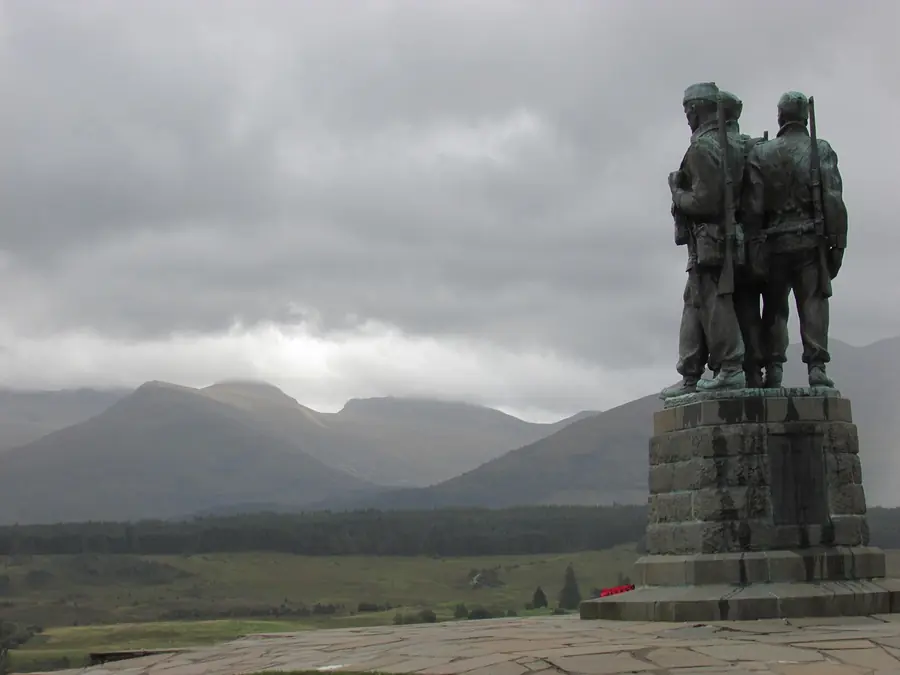
The Commando Memorial stands on open ground a mile from Spean Bridge, thirteen kilometres north-east of Fort William, on the A82. Three bronze figures in Second World War kit, larger than life, stand back to back facing the country they trained in. Ben Nevis and the Aonachs fill the southern skyline when the cloud lifts.
It is one of the best-known monuments in Scotland, and it is not in Fort William. That is the first fact. People type the town into a satnav, park on the High Street, and then discover they are a quarter of an hour up the glen from the thing they came to see. Drive to Spean Bridge. Use the memorial’s own car park. Do not treat it as a Fort William street.
Spean Bridge is a village on the West Highland Line, at the junction of the A82 and the road west toward Achnacarry. The memorial sits just north of the village, signed from the main road. From the town it is about fifteen minutes in a car, longer on the bus.
Spean Bridge station is a mile away — the same walk the wartime recruits made in the opposite direction, from the train to the castle. If you are on the line already, that walk is the right approach. If you are in Fort William with a car, the A82 is the approach. There is no benefit to leaving the car in An Aird and coming out by taxi.
Our parking guide is for the town. This stop has its own park.
The figures were sculpted by Scott Sutherland and unveiled in 1952 by Queen Elizabeth The Queen Mother. They are Category A listed, which is the highest grade, and they have the stillness of a war memorial rather than the swagger of a statue.
They stand back to back, looking outward, in the kit of the original Commandos: beret, webbing, boots. The inscription reads United We Conquer. That was the motto. The sculptor put them here because this is the ground, not because it was a convenient lay-by.
The bronzes weather. In rain they darken. In a westerly they are a cold stop even in July. There is no shelter at the statues themselves. The car park sits a short, level walk away; the memorial is on the rise, open moorland at height. It is windy far more often than not.
You can walk around them. You should. The faces are the point, and so is the direction they look.
In 1942 the Commando Basic Training Centre was set up at Achnacarry Castle, a few miles west, and for the rest of the war every British commando — and a large number of American Rangers, French, Belgian, Dutch, Norwegian and Polish troops — passed through this country to be trained in it.
The training used the ground: the mountains, the rivers, the lochs and the weather. Recruits arrived at Spean Bridge station and were marched the seven miles to Achnacarry with full kit as their first assessment. People failed on that walk. The ones who did not went on to a programme that was famously severe, and then to the raids and landings the units were raised for.
The memorial faces that training ground. The figures look south-west across it toward Nevis and Aonach Mòr. The sculptor placed them where he did because the view is the other half of the monument. Take the view away — low cloud, a wet westerly — and you still have the bronzes. You do not have the reason they stand exactly here.
Achnacarry itself is not a visitor attraction in the same way. It remains a private estate and, at times, a training site. The memorial is the public place. Do not drive down to the castle expecting a museum.
Even setting the memorial aside, this is one of the great roadside views in the Highlands. The ground falls away to the south and the whole Nevis range stands across the horizon — Ben Nevis, Càrn Mòr Dearg, Aonach Mòr, Aonach Beag — with the Great Glen running off to the north-east.
On a clear day it is exceptional, and it is why coaches stop. In cloud it is often nothing at all: a grey wall where the mountains should be, and three wet bronzes. That is worth knowing before you drive out specifically. A forecast that gives a cloud base above the summits is the day. A town forecast that says “cloudy” is not enough, because the town sits at sea level and the memorial sits in the open with the range in its face.
Early and late in the day the light on the hills is better and the coaches are thinner. Mid-morning in August is a car park with engines running.
The Ben Nevis page is the mountain. This is the view of it from the north, the side the town does not see.
Below the memorial is a garden of remembrance, added later and still in active use. Families leave crosses, plaques, photographs and ashes here — not only for the wartime commandos but for members of the modern Royal Marines and special forces, including those killed in Iraq and Afghanistan.
It is a working memorial rather than a historic one, and that changes the register of the place. Walk down into it. Be quiet there. Do not treat the tokens as props for a photograph. Dogs on a lead; children told, before you arrive, what the garden is.
The path from the car park to the bronzes is short and level. The garden is down a slope. In ice, that slope is the bit that catches people. In summer it is grass.
There is a free car park on site. Use it. It fills in summer as tour coaches stop, and it empties again when they leave. There is no overflow that you should count on; the A82 is not a place to invent a verge.
Toilets and, in season, a snack van sit by the park. Spean Bridge village, a mile away, has a hotel, shops and the station if you want more than that.
Free, open at all times, no ticket. Twenty to thirty minutes including the garden is the honest visit. Longer if you wait for the cloud to move, which it may not.
Do not park in Fort William for this. Do not park at Old Inverlochy Castle and walk the A82. The castle is a different stop, two kilometres north of town; the memorial is Spean Bridge. Combine them by driving, not by leaving a car in the wrong place.
The two free historic stops north of Fort William sit on the same road.
Old Inverlochy Castle is the thirteenth-century ruin by the River Lochy, fenced, exterior only, a twenty-minute look. Then the A82 to Spean Bridge and the memorial. That order puts the ruin first and the view second, which is the right way to use the light if the afternoon is clearing.
Do not expect the castle to fill an hour. Do not expect the memorial to fill one either. Together they are a morning, with coffee in Spean Bridge, or a late stop on the way back from the Great Glen. The castle piece is the other half.
If you are going on to Glenfinnan, this is the wrong direction. Glenfinnan is west, on the A830. Spean Bridge is north-east. Mixing them up is a twenty-minute mistake at the roundabout.
It is open moorland. Dress for it even if the High Street was mild. The rain guide still applies: the memorial is a five-minute stop from the car in any weather, and the view is the thing you lose when the clag is down.
Coaches use this as a toilet-and-photograph stop on Glen Coe and Loch Ness days. If you want the bronzes without a crowd, do not arrive at the same time as a tour. First thing, or the last hour of a long summer evening, is when the place is a memorial again.
A wet westerly is not a reason to skip it if you are already on the A82. It is a reason not to make it the only outdoor plan of the day.
The attraction page is the short practical list. This page is the reason the figures face the way they do, and the reminder that they do not stand in Fort William. Park at Spean Bridge. Look south. Then go.