The Caledonian Canal leaves salt water at Corpach, climbs through Banavie, and then uses the Great Glen’s own lochs to reach Inverness. The piece of it that people come to Fort William to see is the flight of eight locks at Banavie: Neptune’s Staircase, Thomas Telford’s staircase lock, still working, free to watch, with Ben Nevis on the skyline.
It is three to four kilometres from the High Street, not a day trip. You can walk, take a bus, or take the train to Banavie. You do not need to drive, and on a summer Saturday you are better off if you do not.
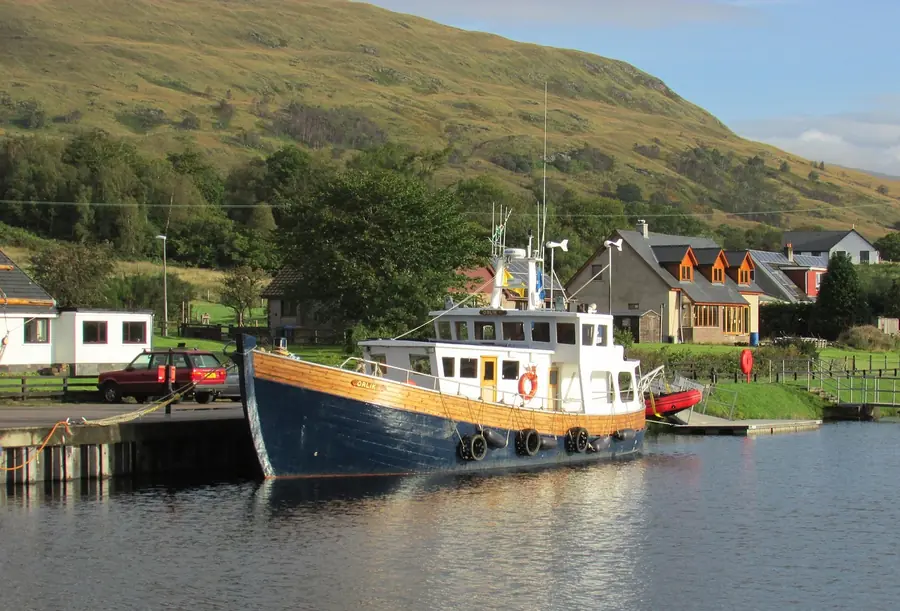
The photograph at the top of this page is a boat on the canal, not the locks. The staircase is a working flight of gates. Stand on the towpath for that.
Neptune’s Staircase sits in Banavie, just north of Fort William, where the canal has to climb into the glen. Eight locks in an unbroken run lift boats about 19 metres over a quarter of a mile. Scottish Canals, who keep it, call it the longest staircase lock in Scotland; it is the longest in Britain. Telford built it between 1803 and 1822.
A full passage takes about ninety minutes to two hours. People who stop for five minutes routinely stay for an hour. There is no timetable you can count on. Traffic is heaviest in the sailing season and in the middle of the day; the lock keepers will tell you what is expected if you ask. Yachts and small commercial vessels are the usual trade, sometimes several at once.
With nothing moving, you have a towpath, a set of gates, and the mountain. That is still a good walk. It is not the spectacle. Arrive hoping for a boat, and have the towpath as the day if the basin is empty.
The system was worked by hand, with capstans, and converted to hydraulic operation in the 1960s. The keepers are on site in season and, by consistent report, willing to explain what is happening if you do not stand in the way.
An ordinary flight has a stretch of water between each lock. A staircase has none: the top gate of one chamber is the bottom gate of the next, so the eight locks are joined in a single run up the hillside.
That makes it efficient in space and slow in operation. Every boat has to be raised through all eight chambers in sequence. Watching it is the pleasure of a machine that still does the job it was built for, at walking pace, in the open.
Telford’s canal runs about 97 kilometres from Corpach on Loch Linnhe to Inverness on the Moray Firth, using the line of the Great Glen and the lochs in it — Lochy, Oich and Ness. Only about a third is man-made cutting; the rest is loch. It was built to let vessels avoid Cape Wrath and the Pentland Firth. By the time it opened, late and over budget, steam had begun to make that passage manageable. It never carried the traffic intended. It survives as a cruising route you can walk beside.
West of the staircase, the canal reaches salt water at Corpach. The sea lock and the basin are the western entrance: boats come off Loch Linnhe, lock in, and begin the climb toward Banavie.
This is the working end, not a park. Corpach has the harbour Fort William itself lacks. The towpath between the sea lock and the staircase is the obvious walk — level, with the mountain behind you as you head inland and the loch when you turn back. The Old Boat of Caol, the beached wooden fishing boat on the shore with Nevis behind it, is a short diversion off the same stretch and takes ten minutes.
Scottish Canals’ Banavie address is PH33 7LY, about three miles from town as they measure it. Corpach is the next settlement west. You can start at either end.
The towpath is the reason this is more than a lock flight.
It runs from the sea lock at Corpach past the staircase and on up the glen toward Gairlochy, flat, surfaced, open to walkers and cyclists. It is the first section of the Great Glen Way, and it is the best easy walking near the town: no bog, no summit, no navigation. Ben Nevis sits behind you heading north-east. The canal does the route-finding.
You can walk as far as you like and turn round. Banavie to Corpach is the short version, twenty minutes each way without dawdling. Banavie toward Gairlochy is the longer, quieter stretch. Our walks guide puts this with the other low-level days, which is where it belongs. It is also the walk to do when the hill is in cloud. The rain guide lists it for that reason.
The railway crosses at the bottom of the flight on a swing bridge. The West Highland Line to Mallaig uses it, and in season the Jacobite comes over. It is still a working railway. Stay off the line. Road and rail both swing for boats; if a yacht is locking through, you may wait at the road bridge.
Banavie is close enough that the car is optional.
On foot, allow the best part of an hour from the High Street. The Great Glen Way is the signed line; the shore via Caol is the other. Neither is a mountain walk. Waterproofs, because this is Fort William; decent shoes, because towpath gravel is still gravel.
By bus, local services run from the town toward Banavie and Corpach. Stops sit by the Moorings Hotel at Banavie and in Corpach village. Frequencies change with school days, Sundays and the season. Check Traveline Scotland for the day you are going.
By train, Banavie station is on the Mallaig line, a short walk from the bottom of the flight. Park once in town, ride one stop, walk the locks.
By car, there is a car park near the garage at Banavie, a short walk from the locks. Scottish Canals describe it as free. Signage is the recurring complaint — visitors miss it in the trees — not a shortage of bays on a quiet day. If you have already parked in town, leave the car there. See parking in Fort William. The attraction page has the short practical list.
The best visit is the one that coincides with a boat. There is no public timetable for that. Mid-morning to mid-afternoon in the cruising months is your best chance. In winter the canal is quieter; the towpath is not.
If something is in the flight, stay the ninety minutes. Move along the towpath as the boat moves. Do not stand on the gates. Dogs on a lead: the drop is real, and the keepers have a job to do.
If nothing is moving, do not wait an hour on the chance. Walk to Corpach, or walk up toward the top of the flight for the view back down the staircase. Then go and do something else. Pubs and cafés sit beside the flight at Banavie, with seats that look at the water. That is the wet-weather version of the same stop.
Three free, or nearly free, historic stops sit on a short line north of the High Street.
The West Highland Museum on Cameron Square is the indoor hour: Jacobite material, the garrison that gave the town its name. Free, donations invited, hours that change — check the museum before you build a morning around it.
Old Inverlochy Castle is two kilometres north, a fenced thirteenth-century courtyard by the River Lochy. Exterior only. Twenty minutes. The castle piece is the warning about the fence.
Then Banavie and the staircase, or Corpach and the sea lock. That is a full half-day on foot if you want it to be, or three short stops with a bus. It is also the right wet-day plan that is not a gem shop: museum, ruin from the outside, canal under a hood. Do not add the Commando Memorial to this walk. Spean Bridge is another ten kilometres up the A82.
Start in town at the museum if the weather is poor, or on the towpath if it is not. Walk or ride to Banavie. If a boat is in the staircase, stay. If not, walk to Corpach, look at the sea lock, and come back the other bank.
The view from the top of the flight is the one to wait for a gap in the cloud for: the mountain and the Mamores across the canal, the eight locks dropping away below. It is the opposite of a summit view, and on many days in Lochaber it is the one you can actually have.
Telford built a shortcut across Scotland that the navy barely used. What remains is a level path, a flight of locks, and a basin where the glen meets the sea. That is enough for an afternoon, and it is the walk this town has when the hill is out.